Building blue economies that are sustainable, inclusive and investable
5 min read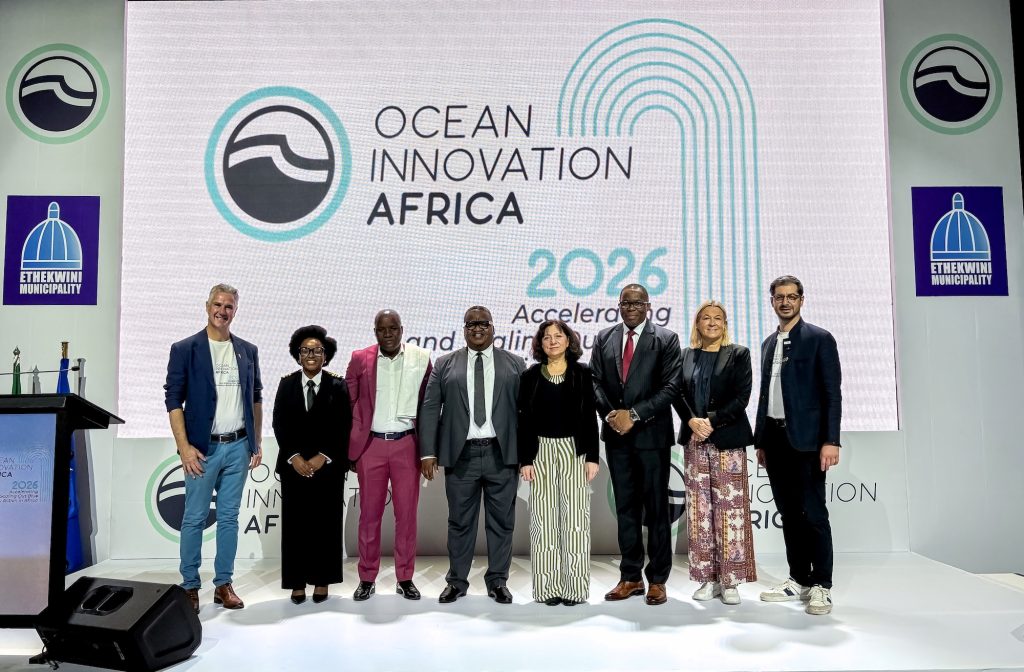
The Ocean Innovation Africa (OIA) Summit 2026, which took place in Durban at the end of March, brought together 581 delegates from 36 countries, generating over 420 business-to-business meetings, showcasing some of Africa’s most investable blue economy ventures and innovations.
Opening the summit with a compelling keynote address, Charlina Vitcheva, director-general of the European Commission’s Directorate-General for Maritime Affairs and Fisheries, emphasised that the future of the blue economy depended on turning political commitment into practical action through Africa–Europe partnership.
“Ms Vitcheva’s message was not simply that the ocean is under pressure,” explained Alexis Grosskopf, co-founder of OIA. “But we now need to move beyond acknowledging the challenges and instead focus on what it will take to accelerate solutions: stronger co-operation, better investment pathways, science-based decision-making and a shared commitment to building blue economies that are sustainable, inclusive and investable.”
It linked high-level political intent, through the European Ocean Pact and the European Union’s co-operation with Africa, with concrete mechanisms such as BlueInvest Africa, fisheries and aquaculture support, regional ocean governance programmes,and new ocean observation efforts like OceanEye. In other words, the message was that partnership must be visible not only in speeches but in finance, institutions, science and implementation.
Building on this, Salma Baghdadi, innovation lead at The Wave Global – an organisation dedicated to regenerating the ocean within one generation – said in her keynote address that ocean regeneration would only happen if the right ecosystem around innovation was built, not just the innovation itself.
She spoke about how all the actors needed to be intentionally connected so that science became solutions, solutions reached markets, and collaboration turned isolated efforts into systemic change.
Several engaging and robust workshops underscored recurring themes for the various interest groups: access to finance remains a bottleneck, locally anchored delivery is preferred over top-down design, and co-ordination is as critical as innovation. These workshops produced tangible outputs ranging from venture incubation to direct community finance and AI-driven ocean literacy tools.
Through the Pecha Kucha sessions, titled “Women of the Blue: Leading the Wave”, women leaders shared powerful stories of reshaping the blue economy: These included Magdalyne Were, regional lead: Gender and head: Blue Economy of Canadian-based Mission Inclusion; Fatuma Mang’ena, co-founder and chief technology officer of Tanzanian-based Healthy Seaweed Co. Limited; and Maryke Musson, executive from Durban of South Africa’s uShaka Sea World / South African Association for Marine Biological Research.
“Their stories demonstrated that women are not only contributing to the sector but are actively driving innovation, resilience and systemic change for people, climate and nature,” said Grosskopf.
The summit revealed the investable opportunities that existed within the sector, with African startups turning waste into value, advancing aquaculture and building cold chain businesses.
Financing conversations moved beyond grants toward blended capital. Concrete outcomes included three OceanHub Africa accelerator graduates – Ambani Fish Leather, Fibertext Green Paper Limited and Chitelix – winning fully funded exposure at Katapult FutureFest, an annual gathering designed to accelerate positive change by uniting, inspiring and empowering a diverse global community of innovators and change-makers in Amsterdam.
At the summit, OceanHub Africa announced the release of its Impact Report (2020–2025), documenting how it had built Africa’s ocean-impact entrepreneurship pipeline and the partner infrastructure that helps ventures move from early traction to investable scale. It highlights 149 businesses supported, $20m+ mobilised, 1 735 blue jobs created and a 90% portfolio survival rate, and outlines concrete ways partners can plug in across venture support, market-making and fit-for-purpose capital.
Going forward, OIA outcomes will be taken to Our Ocean Conference (OOC), a global event that opens in Mombasa in June: “bringing African science, entrepreneurs and communities to the policy platform that OOC is, to sharpen a regeneration-first agenda and package concrete pipelines of ventures and projects”, said Grosskopf.
“Essentially, OIA 2026 facilitates the development of solutions and coalitions, and then amplifies them onto the global stage, such as during Our Ocean Conference.
“We hope that OIA 2027 can return to South Africa, building on this cycle as a recurring African launchpad into global ocean diplomacy and finance.”
Image credit: Casey Pratt