The Club Med Effect: When global tourism capital meets a high-growth coastal market
7 min read
On 4 July 2026, a resort opens on KwaZulu-Natal’s North Coast. That sentence alone doesn’t do it justice.
What is actually happening is that one of the world’s most recognised hospitality brands is planting a flag in South African soil for the first time – and if history is anything to go by, the ripple effects will be felt for decades.
Club Med Tinley is not just a hotel. It is a R2-billion anchor investment comprising 486 keys, a 500-pax convention centre, an 18,000-hectare Big 5 game reserve with its own safari lodge, and the world’s first Club Med to combine beach and bush in a single guest journey.
There is no comparable product anywhere in the Mediterranean, the Caribbean or Southeast Asia. This is a structural first in Club Med‘s 75-year history. And it is happening here.
Here’s the thing. Club Med has done this before. Not once. Repeatedly.
In 1976, Cancun was a fishing village with roughly 120 residents and zero hotels. Club Med was among the first operators to break ground. Private investors had been reluctant to commit to an unknown stretch of sand in one of Mexico’s poorest regions. Club Med’s arrival gave the market permission to believe.
Today, Cancun welcomes 21 million tourists a year and generates over $20 billion in annual tourism revenue for the state of Quintana Roo. The city that didn’t exist 55 years ago now produces a third of Mexico’s total tourism income.
In Ibiza, Club Med arrived when the island was still a farming and fishing community. Tourism now accounts for an estimated 90% of the island’s gross domestic product.
In the Dominican Republic, Club Med pioneered Punta Cana before it became one of the Caribbean’s most visited destinations; and more recently opened in Miches, a rural area that is now attracting hundreds of millions of dollars in secondary investment.
A global blueprint for regional transformation
The pattern is consistent. Club Med enters undeveloped regions with natural assets, but no tourism infrastructure. The brand brings international credibility. Other investors follow. Roads get built. Airlines add routes. Employment shifts from subsistence to services. Property values get permanently repriced.
That repricing is already visible on the North Coast. The Club Med Exclusive Collection villas at Tinley have now reached approximately R12 million for a family suite, driven purely by demand and scarcity. With only 64 units released, the market has done the pricing. At roughly R73 000 per square metre, these villas are trading at nearly three times the rate of the very best sectional title product within estates on the North Coast corridor, where the high end is achieving around R30 000 per square metre.
That gap is not a distortion. It is a signal.
Consider the market into which this resort is landing. In 2025, the Ballito, Salt Rock and KwaDukuza North Urban corridor recorded a combined 929 residential transfers worth over R3.2 billion. Average freehold prices are sitting at R4.8 million in Ballito and over R7 million in Salt Rock. The broader KwaDukuza North Urban node saw population growth of 301% between 2011 and 2025, with 173 adults and 115 families arriving every single month. Household income growth across the North Coast corridor has been staggering, with Ballito up 112%, Salt Rock up 273% and KwaDukuza North Urban up 215% over the same period.
This is not a sleepy coastal strip waiting for something to happen. The fundamentals were already moving. Club Med is the accelerant.
The North Coast’s inflection point
What the data actually shows us is that the North Coast has been quietly assembling the ingredients of a world-class lifestyle corridor. Population density is building. Income profiles are strengthening. Estate premiums are hardening, with sectional title properties inside estates commanding 38% more in Ballito and 56% more in Salt Rock compared to non-estate equivalents. Capital appreciation on sectional title stock is running between 5% and 23% annually across the key nodes.
Now add 175 963 annual room nights of international tourism. Add the airline routes that will follow a Club Med opening, as they always do. Add a 500-seat convention centre that positions the North Coast as a MICE (meetings, incentives, conferences & exhibitions) destination for the first time. Add 800 direct jobs and 1 500 indirect jobs, pumping wages into the local economy.
Pricing power and the new coastal premium
I’d be naive not to acknowledge the headwinds. KZN has endured riots, floods and persistent municipal dysfunction since 2020. The province’s tourism market share took a hit, and confidence was fragile. But if you look at the key fundamentals, the story is more nuanced. Completed residential buildings in KZN grew 9% year on year. The repo rate held steady at 6.75% today amid global uncertainty, but the downward trajectory remains intact, and further relief is expected.
And 185 families are still moving to the North Coast every month, regardless of the noise.
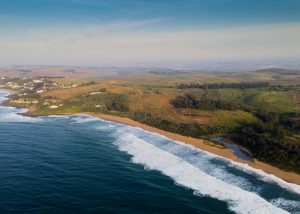
The reality is that Club Med didn’t choose KZN despite its challenges. They chose it because of what the challenges obscure. A coastline with warm-water beaches, year-round accessibility, a game reserve 45 minutes by charter flight, and a residential market that is growing faster than almost any comparable node in the country.
If you’re a developer sitting with land on the North Coast, the question is no longer whether a premium product can work here. R88 000 per square metre has answered that. The question is how quickly the broader market recalibrates upward as the international spotlight lands.
If you’re an investor, consider this: Every market Club Med has entered has seen sustained, long-term property value appreciation in the surrounding area. This isn’t speculation. It’s arithmetic – and it has a 75-year track record.
The Club Med Effect is not about one resort. It is about what one catalytic project does to an entire region’s trajectory. Cancun proved it. Punta Cana proved it. The North Coast is next.
And the market is about to find out what happens when the world discovers what KZN already knows.
Stefan Botha
Director