Lighting solution improves nighttime business for shisanyama traders in Langa
7 min read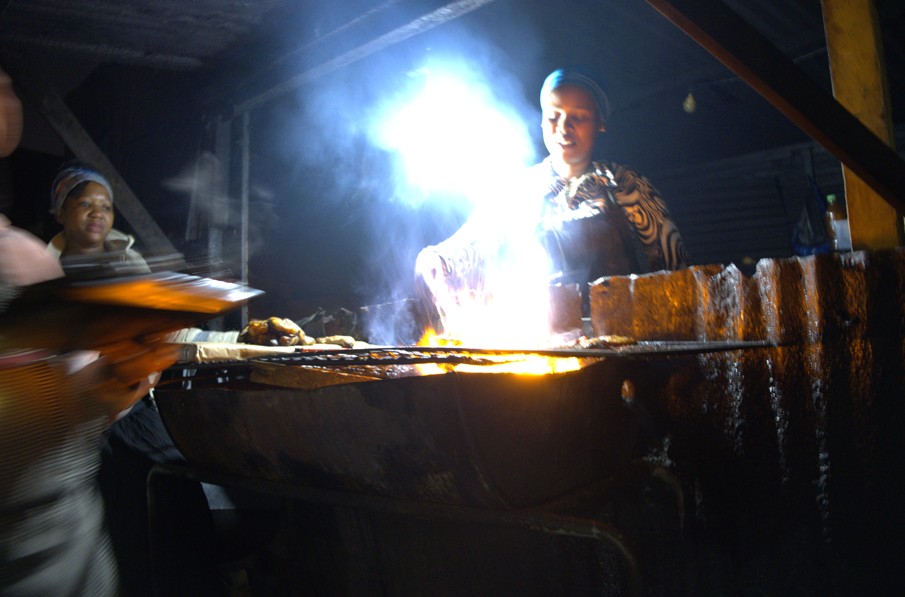
At night, Albert Luthuli Street in Langa is a hive of activity, with traders serving up freshly prepared street food. For years, this vibrant food economy has relied on candles and gas lamps, creating unsafe, unreliable and stressful working conditions for the informal traders: women who work well past midnight.
A new pilot project is beginning to change that – introducing small, co-designed energy solutions.
Under the AfriFOODLinks Project, the South African Urban Food & Farming Trust (SAUFFT) has partnered with Ranyaka Community Transformation, Ener-G-Africa (EGA) and the City of Cape Town to support traders and strengthen urban food systems through improved energy solutions.
“This pilot shows what’s possible when energy solutions are designed with people, not just for them,” says Andre Moolman, CEO of EGA. “By listening carefully and adapting to how informal traders work, we can deliver energy access that is safe, dignified and genuinely useful. We pride ourselves on developing African solutions for the African context. It’s exciting to supply local traders with a solar kit designed and manufactured right here in our Paarl factory.”
“This project was an easy win,” says Guy Campbell, project manager for Ranyaka and lead designer for the lighting project. “Traders wanted lighting and we’ve managed to give them a solution that works. It has provided an invaluable foundation of trust and confidence with the group.”
A broader approach to food security
AfriFOODLinks is a European Union–funded programme working across African and European cities to strengthen urban food systems. When the AfriFOODLinks team consulted traders, lighting emerged consistently as a priority.
Before the intervention, a tipped-over candle could quickly spark a fire. Working in the dark also amplified safety risks and impeded traders’ ability to manage cash and process sales.
The Langa lighting pilot provides informal traders with safe, portable hybrid-solar lighting tailored to their working conditions. The solution was developed through an iterative co-design process involving traders and a design team from AfriFOODLinks, Ranyaka and EGA – a practical example of how urban food systems can be strengthened by bringing stakeholders together.
“Lighting wasn’t just an inconvenience,” says Portia Cabilitye, a trader on Albert Luthuli Street. “It affected how safe we felt, how we worked and how customers approached us.”
Context-specific solutions
“The land where the traders are situated belongs to the City of Cape Town and has many complexities providing a set of unique challenges. It was important to understand the City boundaries/limitations and find opportunities for intervention that would still deliver impact for the traders,” says Rirhandzu Marivate from SAUFFT.
Rather than imposing a pre-packaged solution, project partners worked closely with traders, who made it clear that any lighting system would need to be portable, last 4 to 6 hours and be affordable. Fixed rooftop panels were rejected due to theft and vandalism risks.
EGA and Ranyaka developed a lighting kit that did not yet exist in the market, including a small solar panel kept at home for safe charging, portable power banks and a compact LED light that provides steady illumination. Traders can charge the lights by solar panel or through the power grid on rainy days. The power banks power a single light for six hours, or two lights simultaneously for three hours.
Early trials revealed many traders work later than initially anticipated. Battery capacity was adjusted, and dual power banks introduced, allowing for six hours or more of continuous lighting with two bulbs – a direct response to trader feedback.
In the first rollout, completed in April 2025, 22 traders received lighting kits. Pilot participants report better nighttime working conditions, feeling safer and better able to focus on their work. Customers are more comfortable approaching well-lit stalls, and traders are no longer forced to rush or shut early due to darkness or loadshedding.
Traders have also found the lights useful beyond the trading space, with some carrying the lights home for household lighting. This solution has catered for needs beyond its primary purpose, a good indication of the lighting’s fit in African urban environments.
“This solution is benefiting the community and the meat market itself,” says Ward 52 Cllr Thembelani Nyamakazi. “We have had no regrets working with you, [the AfriFOODlinks team], and it is with no regrets that we look forward to continue the work.”
“The lights are doing a good job at Albert Luthuli,” adds Phumzile Yawa, community liaison for Area Economic Development. “When we interviewed the ladies, they were spending hundreds of rands buying candles. Now they don’t have problems with light. Robberies are no longer happening. They used to complain that people would hustle them with short money [when there was no light]. The lights are very helpful to them.”
Potential to scale
The project partners believe the Langa lighting pilot offers a powerful, replicable model for informal trading environments across African cities.
“It demonstrates how low-cost, flexible solutions, when shaped by communities themselves, can have exponential impact,” says Moolman. “It also highlights the role of informal urban traders in food systems work – the people feeding African cities.”
“Simple and affordable, that’s why this solution works” says Campbell. “The system costs R350 in total. We estimate that traders spend upward of R1 500 on candles annually. This an economical solution, never mind the elimination of the fire risk.”
Adds Marivate, “It was important to ensure solutions would truly address the needs of the traders within their current environment. At the same time, we appreciate that it was also important to approach this with the lens of scalability and replicability to other traders and communities in future.”
The next planned intervention is at Smiley Market, a longstanding informal marketplace in Langa known for selling ‘smiley’ (boiled sheep’s head), where an infrastructure upgrade is underway. Based on the Langa lighting pilot, EGA has been asked to assist with solar solutions.
Discussions are underway to replicate the Langa pilot in other high-density trading areas of Cape Town, and other AfriFOODLinks partner cities in Africa.