Learning Indaba 2026 highlights AI, performance impact and the future of work
7 min read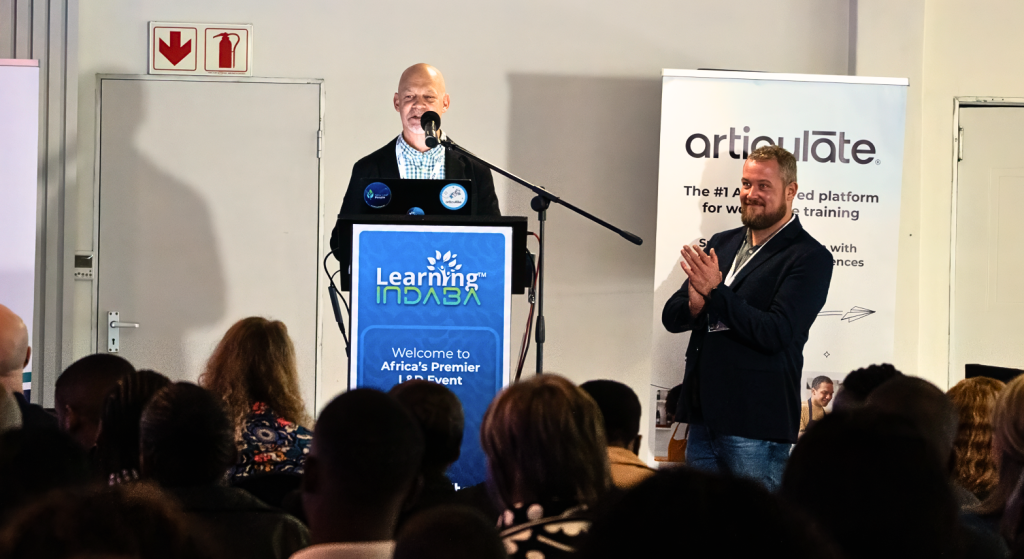
South Africa’s learning and development (L&D) sector is entering a period of rapid transformation, with new insights from this year’s Learning Indaba 2026 confirming the industry is shifting decisively from traditional training models to performance-driven, technology-enabled learning ecosystems.
Valued at approximately R22 billion, South Africa’s corporate training and executive education market is expanding rapidly, with companies expected to invest over R30 billion in employee development in the coming years. This growth is being fuelled by digital adoption, persistent skills shortages and the urgent need to address unemployment, currently sitting at around 32.9% (youth about 46%), positioning L&D as a critical lever for economic resilience.
These macro trends were brought sharply into focus at the Learning Indaba 2026, hosted by New Leaf Technologies, which brought together more than 250 in-person delegates and hundreds more online to explore the future of workplace learning.
From ‘training’ to business-critical performance
A central theme emerging from the conference was the need for L&D to move beyond traditional training models and focus on measurable business outcomes.
Opening the event, Michael Hanly, managing director of New Leaf Technologies, challenged organisations to rethink the role of learning: “If you’re presenting completion rates in the boardroom, it’s like bringing a ping pong paddle to Wimbledon. Executives want to know: Did this generate profit, did it save money and did it improve performance? If you can’t answer that, you’re guessing.”
He noted that L&D is undergoing a fundamental shift, from a reactive support function to a strategic driver of performance. “We have to move from being order-takers to performance architects. If training isn’t improving performance, it isn’t training – it’s noise.”
This reflects broader global shifts, where artificial intelligence has risen to become the number-one priority in L&D, overtaking traditional focus areas such as delivery platforms and content libraries.
AI, personalisation and the end of ‘one-size-fits-all’ learning
The conference highlighted how AI is fundamentally reshaping the delivery of learning, with organisations moving toward real-time, personalised and performance-integrated learning experiences.
Hanly emphasised that static training models are becoming obsolete: “In a world where employees are used to technology that adapts to them in real time, they will no longer tolerate one-size-fits-all learning. They expect learning that meets them exactly where they are, at the moment they need it.”
This shift aligns with national trends, where 65%–75% of South African organisations are expanding digital learning, and the e-learning market, currently valued at R43 billion (US$2.36 billion), is projected to grow to over R118 billion (US$6.44 billion) by 2030.
The business case for adaptive learning
International speakers demonstrated that modern learning approaches are not only more effective, but significantly more efficient.
Research presented at the Indaba showed that adaptive learning can reduce training time by up to one-third, while maintaining or improving outcomes. In one example, training time decreased from 2 hours 9 minutes to 1 hour 25 minutes, with equivalent performance results.
At scale, the financial impact is substantial. A healthcare case study revealed potential savings of approximately R77 million (£3.3 million) every two years from a single training programme.
The implication is clear: L&D is rapidly transitioning from a cost centre to a strategic business investment.
Storytelling, engagement and human-centred learning
Alongside technology, the conference also highlighted the importance of human-centred design in learning.
Jonathan Hill, UK-based e-learning specialist, emphasised the role of storytelling in driving engagement and retention: “The difference between content that is consumed and content that is remembered, lies in narrative. When learning follows a story structure, it becomes something people experience – not something they click through.”
This insight reinforces a broader challenge raised throughout the event: disengagement with traditional e-learning.
As Hanly pointed out: “If your employees are rushing through your content, you’re not building skills – you’re burning budget.”
A new model: Learning as a continuous performance ecosystem
A key takeaway from the Indaba was the emergence of new frameworks that position learning as an ongoing, integrated system rather than a once-off event.
The Synapse model introduced at the conference outlines a future where learning is:
- Continuously aligned to business strategy.
- Measured through predictive ‘yield’ rather than retrospective metrics.
- Embedded directly into workflows.
- Powered by AI-driven personalisation.
- Governed by evolving ethical and compliance frameworks.
Hanly explained: “The future of learning isn’t about delivering knowledge. It’s about building the systems that connect people to knowledge in real time – and drive performance.”
Balancing opportunity with risk
While the opportunities are significant, the conference also highlighted the growing risks associated with AI adoption.
Experts warned that AI is increasing organisations’ exposure to cyber threats, particularly through automated social engineering and phishing attacks. As AI becomes more embedded in business systems, governance, ethics and data protection are becoming critical priorities.
South Africa’s leadership role on the continent
South Africa continues to lead the continent’s L&D market, accounting for approximately 22.1% of Africa’s e-learning sector, underpinned by strong infrastructure, institutional capacity and corporate demand.
With Africa’s e-learning market projected to reach R155 billion (US$8.39 billion) by 2034, South Africa is well positioned to remain at the forefront, particularly as digital learning segments continue to grow at 18%–24% CAGR – far outpacing global averages.
A call to action
The overarching message from Learning Indaba 2026 was clear: Organisations must act now to modernise their learning strategies.
Those that successfully align learning with performance, embrace AI and prioritise measurable impact will gain a significant competitive advantage.
As Hanly concluded: “We’re no longer course creators. Our role is to engineer how organisations adapt.”