SA businesses don’t have a software problem – they have a judgment problem
7 min read
South African businesses have become highly effective at producing software quickly. What remains far less clear is why this increased engineering velocity is failing to translate into commercial growth for many companies.
That is the central finding of the 2026 State of Product Development Report, released this month by Cape Town–based digital product consultancy, Specno. The report outlines the 10 capabilities now defining how scaling product teams turn digital products into revenue, and names the widening performance gap between companies that ship features and those that actually compound revenue growth.
The report draws on insights from a council of group CEOs and senior product operators, observed performance patterns across hundreds of embedded engagements, and field-tested applications inside live product teams across the emerging market landscape.
Collectively, those engagements span organisations responsible for billions of rand in annual economic activity, including regulated financial institutions and pension funds, fast-moving consumer goods and food businesses, logistics operators, venture-backed fintechs scaling across South Africa and the broader African continent, marketplaces and enterprise digital platforms.
This is not a survey; it is a benchmark built from direct operational exposure.
The findings arrive at a critical inflection point for South Africa’s digital economy. Businesses across fintech, SaaS, logistics, marketplaces and digital services are facing a fundamental shift: Artificial intelligence has collapsed the cost of building software, meaning shipping velocity is no longer a competitive moat. In fact, one fintech profiled in the report runs its build operation on more than 900 AI agents and 173 connected tools, turning a voice note into a compliant plugin from a near-empty prompt.
When building becomes that cost-effective, the constraints move from production to decision-making, and most teams are still investing heavily in the part that machines already do.
One of the report’s more striking conclusions is that the strongest teams have quietly shifted from a build culture to a review culture.
As AI continues to drive the cost of production toward zero, competitive advantage no longer comes from writing more code but from exercising better judgement about what should be built, what should be rejected, what deserves prioritisation and how work should be sequenced. Increasingly, AI handles the production while humans provide the critical oversight, challenging assumptions, reviewing outputs and making the decisions that shape successful products.
“The market has become very good at measuring output,” says Joshua Harvey, CEO at Specno. “What many businesses still struggle to measure is whether the systems underneath that output are mature enough to sustain growth effectively over time.
“The bar for turning product into revenue has risen sharply in the last 24 months. Capital is harder to raise. Compounding it is harder still. The gap between teams that compound their gains and those that stall continues to widen with each passing quarter.”
According to the report, one of the biggest misconceptions in modern product development is that shipping more software creates more growth. In practice, the opposite often proves true. The highest performing product teams observed by Specno shipped 30% to 50% less at the minimum viable product stage than their peers, yet consistently outperformed them commercially. They converted engineering effort into revenue at two to three times the industry average, responded to market signals an order of magnitude faster, and treated every product decision as a measurable commercial bet rather than another feature release.
Their roadmaps were not longer. They were just deliberate.
The report identifies Product Decisioning as the weakest capability across the market, a pattern confirmed at both ends of the maturity curve. One example involved a premium direct-to-door seafood business turning over several million rand a month while making daily pricing decisions on instinct rather than customer evidence. Another was a funded startup that scored lowest on evidence and validation in its own assessment. Neither had a product problem first.
The report introduces what Specno calls the “Product-to-Revenue Capability Stack”: a three-layer model covering Product Decisioning, Delivery Velocity and Revenue Conversion. The report identifies 10 core capabilities that consistently distinguish high-performing, compounding product teams from those that stall, regardless of industry, business model or stage of growth.
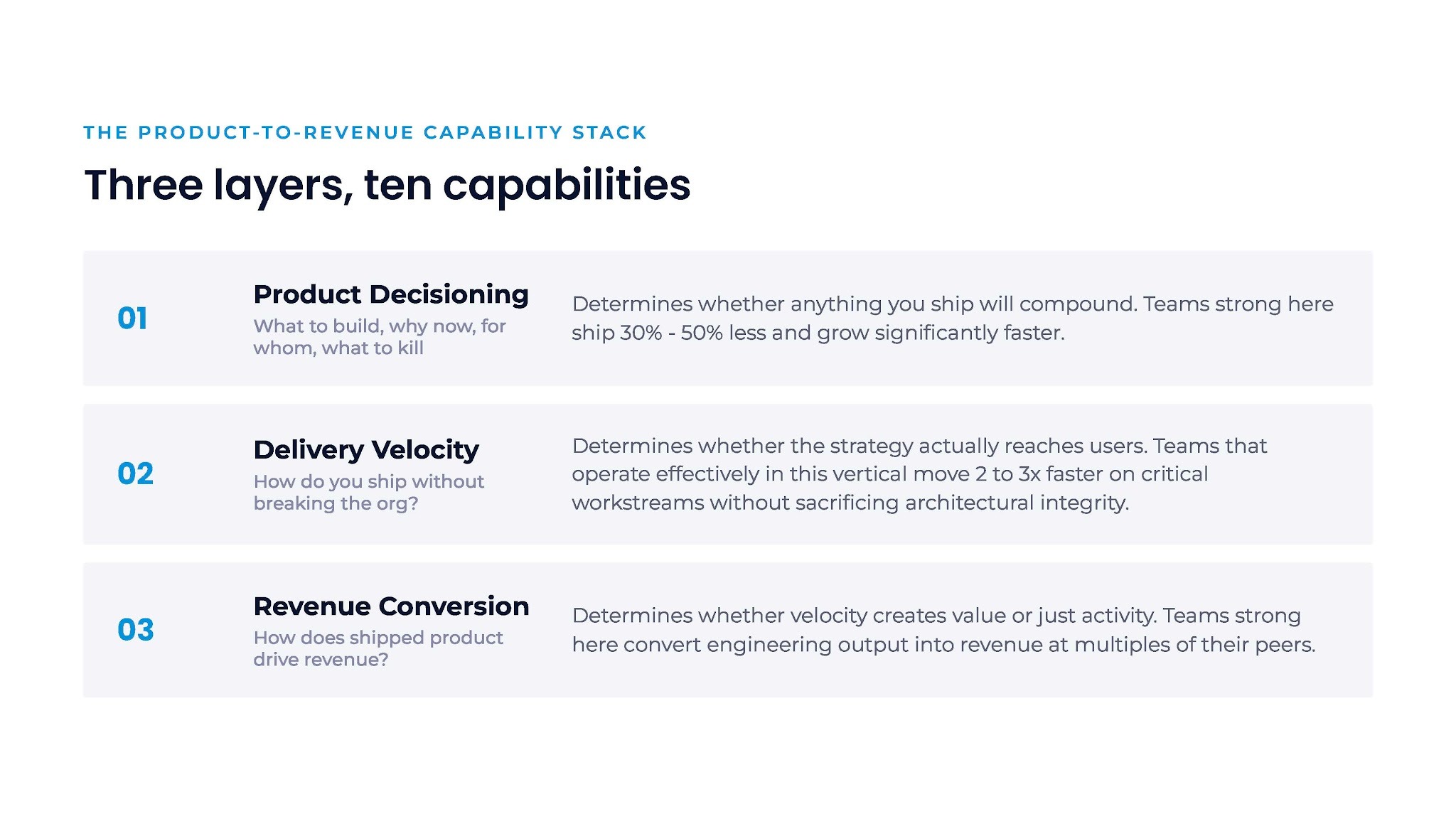
“We developed this report because we realised there was no structured way for businesses to properly evaluate the maturity of their product environments,” says Harvey. “After working alongside organisations ranging from regulated financial institutions and pension funds to fast-growing fintechs, FMCG businesses and enterprise platforms operating across Africa, the same capability patterns kept emerging. Many tools measure isolated technical outputs, but very few assess whether the wider operational environment supporting a product is actually capable of sustaining long-term growth. Most product teams are operating below the standard the market now demands, and they can feel it without being able to name it.”
For South Africa’s fintech operators, SaaS founders, logistics platforms and enterprise product leaders, the implications are direct. The report argues that AI is not a standalone capability but table stakes, an amplifier that makes weak capabilities more visible and strong capabilities faster and more scalable. The question in 2026 is not whether a team uses AI, but whether they use it to operate at a higher level across the capabilities that actually drive revenue.
“One of the things we realised very quickly is that there is still very little shared industry insight into what operational pressure inside scaling digital businesses actually looks like,” closes Harvey. “We believe there is real value in consolidating that information in a way that helps businesses better understand the patterns, capability gaps and operational risks emerging across the market.
“The teams that win in 2026 are not the ones doing more. They are the ones building the capabilities that matter, and knowing exactly how strong they are.”